
Last updated on April 1st, 2026 at 03:29 am
The New York Kill Zone is a trading strategy that integrates price and time, focusing on specific windows of high volatility. This approach lets traders spot high-probability setups using institutional reference points like fair value gaps (FVG) and order blocks (OB).
Kill zones are specific windows during the trading day when institutional traders, banks, hedge funds, and large financial institutions are most active. These are the sessions with the highest volume, the sharpest moves, and the most significant liquidity grabs. When smart money is actively placing orders, price behaves with purpose. Trading outside these windows often means fighting noise.
Kill zones fall into two categories: the London kill zone and the New York kill zone. While the focus here is on the New York kill zone, everything taught applies equally to the London kill zone.
- London Kill Zone: 02:00 AM to 05:00 AM NYT UTC-5. This corresponds to 07:00 AM to 10:00 AM London time. London runs 5 hours ahead of New York during standard periods.
- New York Kill Zone: 07:00 AM to 10:00 AM NYT UTC-5. The US market opens and a second wave of institutional activity begins, especially where it overlaps with the tail end of London.
Understanding these windows gives traders a framework for timing entries based on when smart money is actually moving price, not random hours with low participation.
Why Kill Zones Matter
Kill zones matter because this is when smart money is most likely to push price into liquidity zones, run stop losses, create false breakouts, and then commit to the real direction. Working within these windows offers three real advantages.
- Higher liquidity: Orders fill cleanly with minimal slippage.
- More volatility: Larger moves happen in a shorter time.
- Institutional order flow: You are working with the market’s actual direction rather than fighting manufactured noise.
Strategy Summary Table
| Parameter | Details |
| Time Frame | 30 min | 15 min | 5 min | 1 min |
| Institutional Reference Points | Fair Value Gap (FVG), Break of Market Structure, Sell Side Liquidity (SSL) + FVG, Buy Side Liquidity (BSL) + FVG |
| Model Type | Intraday Trading / Day Trading |
| Narrative | Liquidity taken out AFTER 07:00 AM New York Time (NYT UTC-5) |
| Trading Window | Frame setup before 07:00 AM NYT UTC-5. Anticipate either SSL or BSL being collected. Look for FVG entry during New York Kill Zone 07:00 to 10:00 AM NYT UTC-5 |
| London Close / Profit-Taking Hour | 10:00 to 11:00 AM NYT UTC-5. Major retracements are common here. Take profit before this window opens. |
| Recommended Broker | IC Markets, Raw Spread Account |
Time Rules
- Before 07:00 AM NYT UTC-5, mark previous highs and lows where price is most likely to collect liquidity
- After 07:00 AM NYT UTC-5, expect either BSL or SSL to be collected and start watching for setup formation
- From 07:00 to 10:00 AM NYT UTC-5 (New York Kill Zone), look for FVG entry after liquidity has been collected
- 10:00 to 11:00 AM NYT UTC-5 is the London Close profit-taking window. Most sessions see a major retracement here. Protect profits before this window opens.
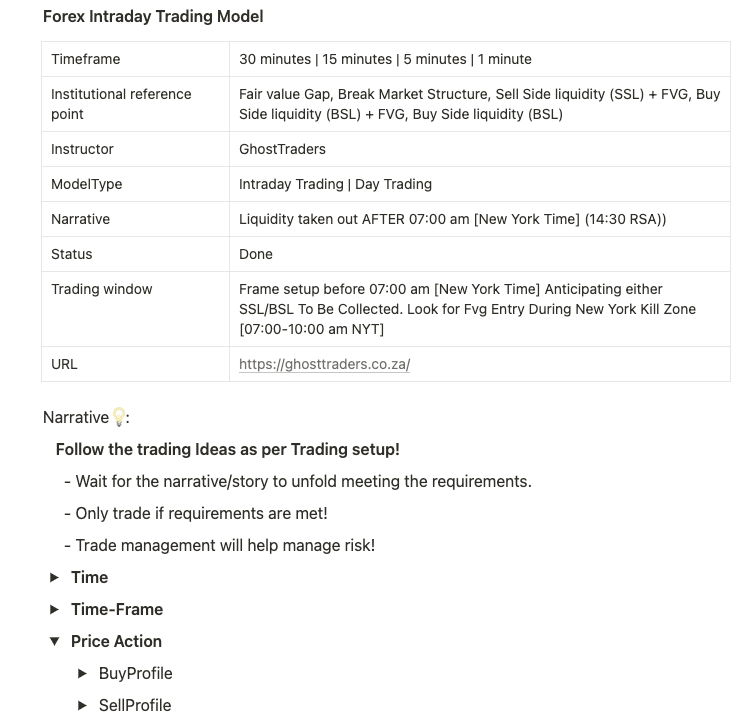
| Time Frame: | 30 minutes | 15 minutes | 5 minutes | 1 minute |
| Institutional reference point: | Fair value Gap, Break Market Structure, Sell Side liquidity (SSL) + FVG, Buy Side liquidity (BSL) + FVG, Buy Side liquidity (BSL) |
| Model Type: | Intraday Trading | Day Trading |
| Narrative: | Liquidity took out AFTER 07:00 am [New York Time] |
| Trading window: | Frame setup before 07:00 am [New York Time] Anticipating either SSL/BSL To Be Collected. Look for Fvg Entry During New York Kill Zone [07:00-10:00 am NYT] |
| Instructor: | GhostTraders |
| Status : | Done |
| Website: | https://ghosttraders.co.za/courses |
| Recommended Broker | ICMarkets, Account Type : Raw Spread |
Time
- Prior 07:00 am Mark Previous Highs and Lows Were Price Is Mostly Likely To Collect Liquidity.
- After 07:00 expect either BSL/SL To be collected and start hunting for setup formation
- From New York Kill Zone[07:00-10:00]Look FVG entry After Liquidity Has Been Collected
- Landon Close Profit Taking Hour is 10:00-11:00 [ Mostly we see a major Retracement during this time, therefore, its best to take profit]
How to Trade the London Kill Zone
The London Kill Zone is one of the most important windows for forex traders. London is the largest forex market in the world and the session tends to set the tone for the entire day. When the London session opens, institutions in the UK and Europe are placing their orders. That creates the liquidity conditions that drive real price moves.
London Session Time Windows
- Pre-London (01:00 AM to 03:00 AM NYT UTC-5): Institutional players start positioning before the official open. Some volatility begins here as large participants prepare.
- London Open (03:00 AM to 05:00 AM NYT UTC-5): This is where the bulk of activity happens. Large price moves, liquidity grabs, and breakouts are most common in this window.
- Late London Session / NY-London Overlap (07:00 AM to 09:00 AM NYT UTC-5): Volume picks up again as two major markets are active at the same time. This overlap produces some of the largest moves of the day.
How to Frame a London Setup
- Before the kill zone begins, mark the highs and lows from the Asian session. These are the liquidity levels smart money targets first.
- Watch for a liquidity grab at the open. The first move is often a stop hunt above the Asian high or below the Asian low. Wait for it rather than chasing it.
- After the liquidity grab, look for a market structure break in the opposite direction. That break is confirmation that smart money has committed.
- Enter on the failure swing when price fills a fair value gap that formed during the structure break.
Stick to major pairs during the London session. EUR/USD and GBP/USD provide the clearest setups because they have the most liquidity and react most predictably to institutional order flow. Avoid exotic pairs during this window.
How to Trade the New York Kill Zone
The New York Kill Zone is the second major window, especially powerful when it overlaps with the London session. The US open brings fresh institutional orders that add to the volume already in the market from Europe.
Key Characteristics
- The London and New York overlap creates the highest liquidity window of the entire trading day
- The New York session either continues what London started or reverses it
- Major economic data releases frequently hit during this session, causing sharp one-sided moves
How to Frame a New York Setup
- Before 07:00 AM NYT UTC-5, review the London session price action. Identify whether the market has been trending or ranging. This tells you whether New York will continue or reverse.
- Check the economic calendar before anything. If NFP, CPI, or another high-impact release is scheduled, do not enter just before the number drops. Wait for the reaction.
- If London established a strong trend, look for continuation setups. If London showed exhaustion or a clear range, watch for reversal.
- Use the order blocks and fair value gaps created during London to guide your entries in New York. A retracement into a London order block during the New York session is one of the cleanest setups this model produces.
Framing a Buy setup and Sell setup using New York Kill Zone
This checkbox list on how to frame a buy and sell setup
You can get this complete template below and duplicate it in your nation

Buy and Sell Setup Checklists
Buy Setup Checklist
- Sell Side Liquidity (SSL): Identify a previous low or equal lows before 07:00 AM NYT UTC-5
- Clearing SSL: After 07:00 AM NYT UTC-5, price trades lower to take out that sell side liquidity
- Swing Low: Price creates a new swing low
- Shift in Market Structure Higher: Price trades back up and breaks the short-term high
- Bullish Fair Value Gap: Anticipate buy entry using the FVG created during the shift higher. After the structure shift, wait for a retracement back into that gap before entering
Sell Setup Checklist
- Buy Side Liquidity (BSL): Identify a previous high or equal highs before 07:00 AM NYT UTC-5
- Clearing BSL: After 07:00 AM NYT UTC-5, price trades higher to take out that buy side liquidity
- Swing High: Price creates a new swing high
- Shift in Market Structure Lower: Price trades back down and breaks the short-term low
Bearish Fair Value Gap: Anticipate sell entry using the FVG created during the shift lower. After the structure shift, wait for a retracement back into that gap before entering
The videos below will help you understand more
Risk Management
Risk 1% per trade. 2% is the absolute maximum and only in high-conviction setups. 1% is what keeps you in the game long enough to get good at this.
- Entry: At the failure swing, where price fills the fair value gap
- Stop Loss (Sell): Above the most recently created swing high
- Stop Loss (Buy): Below the most recently created swing low
- Take Profit (Sell): The nearest swing low that formed before 07:00 AM NYT UTC-5
- Take Profit (Buy): The nearest swing high that formed before 07:00 AM NYT UTC-5
Execute trades on the timeframe where price action met all the requirements.
Trade examples

When to Skip the Kill Zone
Not every London or New York kill zone is worth trading. Knowing when to sit out is just as important as knowing how to enter.
1. Pre-Major News Events
If central bank rate decisions, CPI, or NFP figures are scheduled during or shortly after the kill zone, institutions often hold back until after the release. Price drifts without clear direction. Wait for the New York session to confirm the trend after the news drops.
2. Bank Holidays and Low-Participation Days
During UK, US, or EU bank holidays, institutional participation drops sharply. The kill zone may open on the clock but the volume needed to create real setups is not there. False signals and whipsaws are common. Check the economic calendar for G7 summits and central bank conferences too.
3. Range-Bound or Choppy Markets
If the Asian session failed to create meaningful highs or lows and the previous day’s range was tight, the London open may not deliver a clean break. Institutions accumulate quietly during prolonged consolidations. Wait for a confirmed breakout before entering anything.
4. When the New York Session Holds the Real Driver
If an FOMC announcement is scheduled for New York, institutions are unlikely to commit during London. Use the London session to identify liquidity zones and order blocks at the 4-hour and daily level. Then trade the New York reaction instead.
5. Conflicting Market Structure Across Timeframes
If the daily chart says bullish but the one-hour chart shows bearish momentum, institutions are not aligned. Wait for structure to line up before taking a trade. Look for a market structure shift during the London session to confirm direction before committing.
6. Post-News Event Price Action
If a high-impact event fired just before the London session opened, price often enters a messy cool-down period. Setups are low quality during this cool-down. Let the dust settle and watch the New York PM session for clearer direction.
What to Do Instead When You Skip London
- Focus on higher timeframes: Mark your order blocks and liquidity pools on the 4-hour and daily charts and wait for the New York session to deliver confirmation.
- Monitor the New York Kill Zone: Use the Asian session highs and lows as your reference points for New York liquidity grabs.
Trade the retest instead of the breakout: If London broke out on low participation, wait for a retest of the broken level during New York rather than chasing the initial move.
Combining London and New York Kill Zones
The most powerful part of the New York kill zone is the overlap with the London session from roughly 07:00 AM to 09:00 AM NYT UTC-5. Both regions are active at the same time and volume from two major markets creates the sharpest and most committed moves of the day.
- The price moves established during the London kill zone either continue into New York or reverse sharply. Prepare for both by studying London structure before the NY open.
- A market structure shift during London often signals a new trend that New York reinforces. If no MSS occurred in London, New York may just continue the existing direction.
- Look for liquidity grabs and stop hunts during the overlap. Institutions use this high-liquidity window to trigger stops and fill large orders before committing to direction.
Summary
The London and New York kill zones are the two most important time windows for day traders using smart money concepts. The setup is always the same in structure: mark liquidity, wait for the grab, confirm the structure shift, enter on the FVG, and protect the trade with a stop below or above the swing created by the grab.
The edge is in waiting. Every element on the checklist needs to be present before taking an entry. Trades forced outside these conditions are low-probability by definition.