
Displacement in forex trading is a strong, impulsive price move driven by institutional order flow. It is not just a big candle. It is a move that happens fast, covers a significant range, and leaves behind evidence of institutional participation in the form of a fair value gap.
In smart money trading, displacement is the D in the PO3 (Power of Three) model. After accumulation and manipulation, displacement is when the market commits to its direction. Institutions have positioned themselves, liquidity has been collected, and now price moves aggressively in the intended direction.
The key characteristics that define real displacement are a series of large-bodied candles with minimal wicks, a fair value gap (FVG) left in the body of the move, a clear break of the previous market structure, and a speed that does not give retail traders time to enter comfortably.
If the move you are looking at does not leave a fair value gap, it is not a displacement. That is the most reliable filter.
What Displacement Looks Like on a Chart
Genuine displacement has a specific look. Here is what to check on any timeframe you trade.
The candles are large-bodied. The bodies dominate the wicks. This shows that one side of the market is in complete control, and the move is not being contested.
There is a gap between the high of one candle and the low of the next candle in the direction of the move (or low to high on a bearish displacement). This three-candle structure, where the middle candle’s range is not fully covered by the surrounding candles, is the fair value gap. It is the imprint displacement that leaves on the chart.
The move breaks a significant structural level. Displacement does not happen in the middle of a range. It breaks above a swing high (bullish displacement) or below a swing low (bearish displacement). The break is decisive, and the candles close convincingly beyond the level.
Price does not immediately retrace into the displacement. After real institutional displacement, there is a period where price respects the move before eventually retracing to fill the fair value gap. That retracement is your entry point.
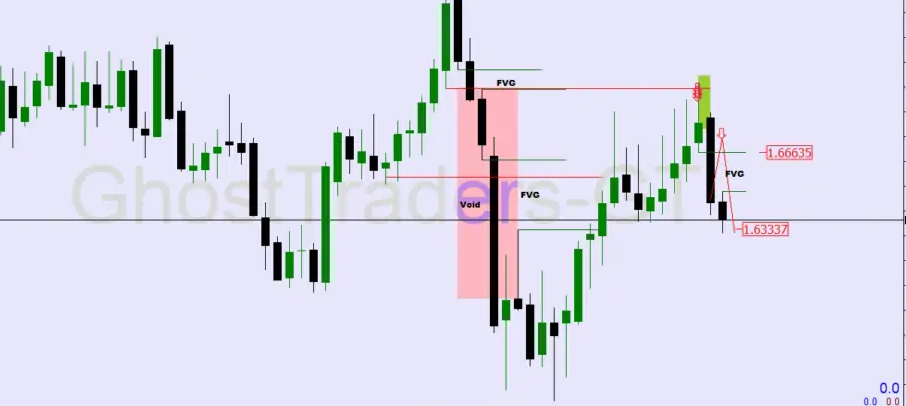
Liquidity Void, which is indicated on the chart below with a fair value gap, is an indication of displacement. The chart example captures this perfectly.
Displacement vs Normal Price Movement
Not every large candle is a displacement. This distinction matters because if you treat every strong move as a displacement, you will be entering trades in the wrong direction constantly.
Displacement: Strong, impulsive candles with large bodies and small wicks. Leaves a fair value gap. Breaks structure. Comes after a liquidity sweep or a period of accumulation. Followed by a pullback that respects the fair value gap before continuing.
Normal Price Movement: Overlapping candles, even if they are moving in one direction. No gap left between candles. Does not break at a significant structural level. Often reverses without any clean retracement opportunity.
The easiest test: look for the fair value gap. If there is no three-candle gap structure in the displacement move, do not treat it as institutional displacement.
Why Displacement Creates a Fair Value Gap
When institutions place large orders, they cannot do so gradually at one price. They need to execute across a range of prices quickly. This creates a rapid, one-sided move where not all orders on the opposite side can be filled. The result is an imbalance in the market, a range of prices where only buy orders or only sell orders were transacted.
This imbalance is the fair value gap. Price is drawn back to these areas because the market seeks to fill the inefficiency. When price returns to the fair value gap, it is offering the opportunity to enter in the direction of the original institutional displacement.
This is why displacement and fair value gaps are always taught together. You cannot use one effectively without understanding the other.
Bullish Displacement vs Bearish Displacement
Bullish Displacement
Price sweeps below a key sell-side liquidity level (previous low, equal lows, Asian session low) and then aggressively reverses upward. The reversal move is displacement. It consists of large bullish candles that break above the recent swing high and leave a bullish fair value gap in the move. This gap becomes your buy entry on the retracement.
Bearish Displacement
Price sweeps above a key buy-side liquidity level (previous high, equal highs, Asian session high) and then aggressively reverses downward. The reversal move is displacement. It consists of large bearish candles that break below the recent swing low and leave a bearish fair value gap in the move. This gap becomes your sell entry on the retracement.
In both cases, displacement comes after the liquidity sweep, not before it. The sequence is always: liquidity collected first, then displacement second.
How to Trade Using Displacement
The trade is not in the displacement itself. You do not chase the displacement candles. By the time you see it, the move is already happening. The trade is in the retracement back to the fair value gap the displacement created.
Here is the approach step by step.
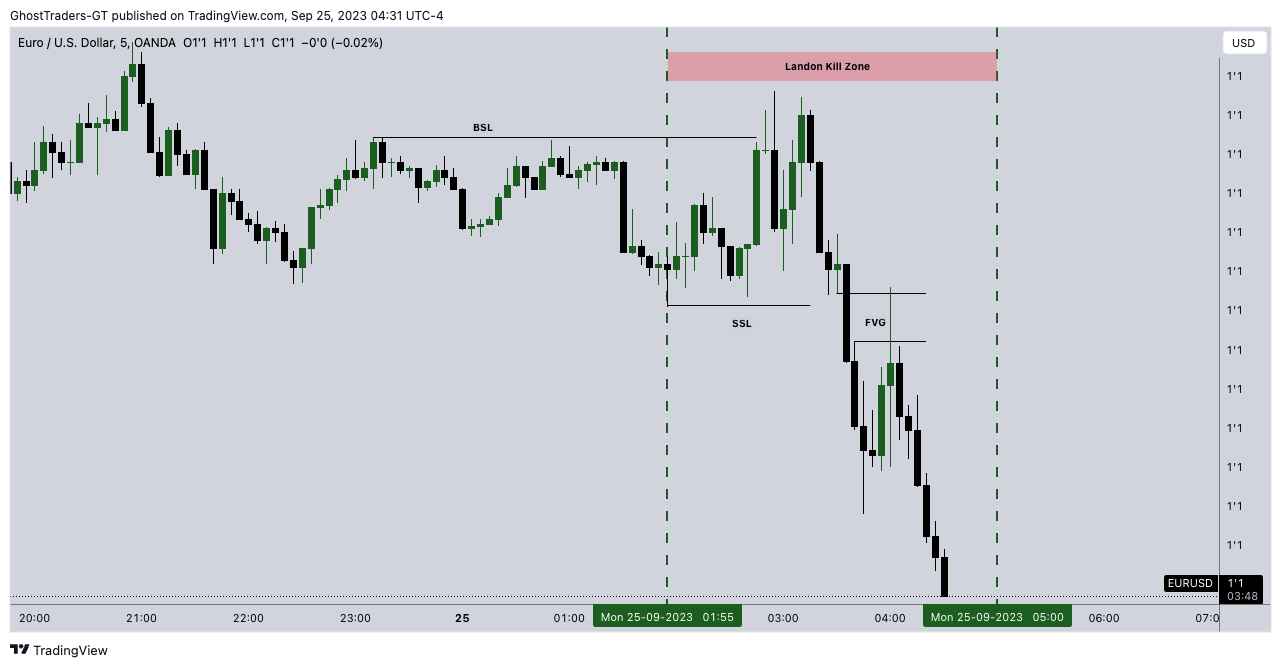
During the kill zone, watch for a liquidity sweep on a key level you marked before the session.
After the sweep, look for displacement moving away from the swept level. Large candles, minimal wicks, a fair value gap forming in the body of the move, and a break of the nearby market structure.
Mark the fair value gap created by the displacement move on your working timeframe (5-minute or 15-minute).
Wait for price to retrace back into the fair value gap. Do not enter early. Wait for price to actually reach the gap.
Enter at the 50% level of the fair value gap or at the first entry candle showing the reversal from inside the gap.
Place your stop loss below the low of the displacement move for a buy, or above the high of the displacement move for a sell. This protects you if the displacement turns out to be false.
Your target is the liquidity pool on the opposite side of the move. This is typically the previous session high or low.
Displacement Trading Checklist
Before the session, mark buy-side and sell-side liquidity levels on your chart
Confirm your daily bias
During the kill zone, wait for price to sweep a liquidity level
After the sweep, identify the displacement move: large-bodied candles, fair value gap, structure break
Mark the fair value gap on your trading timeframe
Wait for price to retrace into the fair value gap
Enter at the 50% of the gap or on a reversal candle inside it
Stop loss beyond the displacement move
Target the opposing liquidity pool
Do not enter after 10:00 AM NYT UTC-5 (London close profit-taking window)
What Is Not Displacement
Getting this wrong leads to bad entries. Here are the things traders often mistake for displacement.
A single large candle without follow-through. One big candle on a news event is not a displacement. Real displacement is a sequence of committed candles moving in the same direction.
A move that does not leave a fair value gap. If every candle in the move overlaps with the previous one, there is no imbalance created, and it is not institutional displacement.
A move during off-peak hours. If the big move happens at 2:00 AM NYT UTC-5 during the dead of the Asian session, treat it with caution. Genuine institutional displacement typically occurs during kill zones when institutional traders are active.
A move that immediately retraces to its origin. Real displacement leaves a gap that price respects for at least some time before filling. If price shoots up and comes right back to the starting point in the next few candles, it was not displacement; it was a stop hunt or a spike.
Displacement and the Power of Three
In the PO3 model, displacement is the third phase. Accumulation happens first as institutions quietly build their positions during a range or consolidation. Manipulation comes next as price sweeps liquidity to shake out retail traders and fill the institutional orders. Then, displacement happens as institutions commit to the direction and price moves aggressively toward the target.
If you understand where you are in the PO3 cycle, you can anticipate displacement before it happens. You do not need to see it to know it is coming. When accumulation has been building and a liquidity sweep has just occurred, displacement is the next logical step. That preparation is what separates reactive traders from traders who are ready.
Summary
Displacement is the market telling you that institutions have committed to a direction. It is fast, impulsive, leaves a fair value gap, and breaks market structure. It happens after liquidity has been collected, not randomly.
Your trade is never in the displacement itself. It is in the retracement to the fair value gap that the displacement is created. Wait for the gap, enter with confirmation, and let the displacement work in your favour.
Study displacement alongside liquidity sweeps and fair value gaps. These three concepts build on each other and form the foundation of the GhostTraders entry model.