
Most traders know that price tends to return to a Fair Value Gap. What few traders understand is the actual reason behind it and how to use that reason to get better entries. This article is not about what FVGs are. It is about the engine running underneath them and a specific entry concept called IOFED that most traders overlook entirely.
The Real Reason Institutions Return to Fill Gaps
When a large institutional order hits the market, it rarely gets filled all at once. The sheer size of the order means that only a portion executes on the initial push. The remainder sits as an unfilled or partially filled order at the price level the institution originally targeted. That level is often sitting inside the Fair Value Gap that just formed.
This is why price returns to these areas. It is not simply because of an imbalance in the abstract sense. Institutions themselves are coming back to complete their own orders. The gap is not just a signal of inefficiency. It is a record of where large players still have business to finish.
Understanding this changes how you look at FVGs. Instead of waiting for price to fill a gap out of habit, you are now waiting for price to return because you know there is a structural reason for institutions to be active at that level again. That reason is order completion, not coincidence.
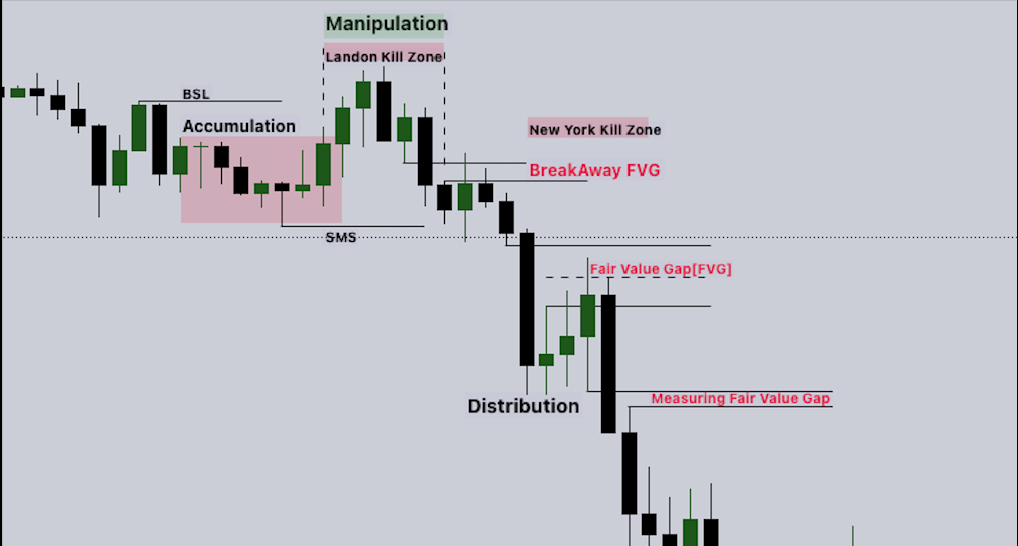
Liquidity is the Prerequisite, Not the Byproduct
Fair Value Gaps do not form in a vacuum. They form specifically where liquidity is thin on one side of the market. When buy-side liquidity is overwhelming, sellers cannot adequately participate, and price skips levels. When sell-side liquidity is one-sided, buyers get left behind. The gap on the chart is the visual evidence of a market that moved faster than both sides could keep up with.
High liquidity environments produce smooth price action with candles that overlap cleanly. Low liquidity environments produce the sharp moves and gaps that FVG traders look for. This means that when you are identifying FVGs, you are really identifying areas where the market moved through a zone without meaningful two-sided participation. Institutions know this, too. They know price will need to return there to find the liquidity required to balance the order flow that was skipped.
From a practical standpoint, this tells you that not all gaps are equal. A gap that formed during a low liquidity period, such as off-session hours or thin market conditions, carries more weight than one that formed during a busy period with reasonable participation on both sides. The thinner the participation at the time of gap formation, the more compelling the reason for a return visit.
What is IOFED and Why It Matters
IOFED stands for Institutional Order Flow Entry Drill. It refers to situations where price retraces into a Fair Value Gap but reverses before reaching the 50% midpoint, known as the consequent encroachment. In other words, institutional order flow is so dominant in one direction that the market does not even need to fill half the gap before continuing the original move.
This matters because it creates an earlier and often cleaner entry opportunity than waiting for a full gap fill or even a fill to the 50% level. If you understand that price is being driven by strong institutional flow, you can anticipate that the gap may only partially retrace before the move continues. Waiting for a full fill or consequent encroachment in those conditions means you miss the trade entirely.
IOFED setups tend to appear when the institutional order flow behind the move is particularly heavy. The market barely pauses, dips into the gap by a small margin, and then continues in the original direction with momentum. For traders positioned correctly, this is one of the highest probability entries you will encounter, precisely because the institutional intent is so clear.
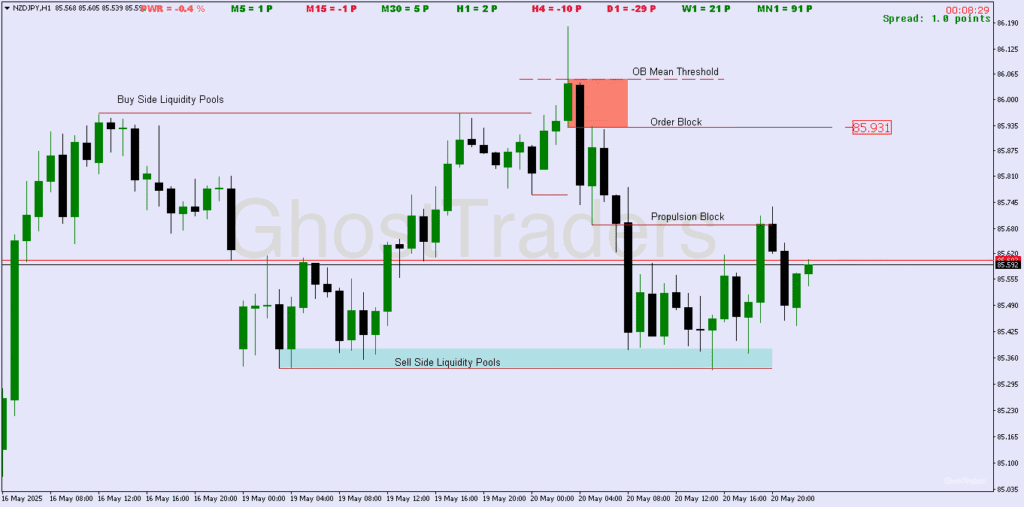
How to Identify an IOFED Setup
The first thing to look for is a strong directional move that leaves a clear Fair Value Gap on the chart. The move should have conviction behind it, meaning large candles, minimal wicks in the direction of the move, and a well-defined gap between the first and third candles.
Once price begins to retrace toward the gap, you are watching for it to slow or stall before reaching the 50% level. If you see price enter the gap slightly and then begin showing signs of rejection, such as a smaller candle, a wick forming in the direction of the original move, or a shift in structure on a lower timeframe, that is your IOFED signal.
The entry is placed as soon as the rejection is confirmed. Your stop goes just beyond the outer edge of the Fair Value Gap in case the setup fails and price continues deeper into the gap or beyond it. Your target remains the original direction of the move, aligned with the next area of interest on the chart, such as a liquidity pool or a previous high or low, depending on the direction.
IOFED vs Consequent Encroachment: Knowing Which One You Have
Consequent encroachment targets the 50% midpoint of an FVG as the ideal entry zone. It works well in trending markets where the gap will partially fill before the move continues. IOFED works better in markets with particularly strong institutional flow, where even a 50% fill is too deep.
The way to tell which one applies is by looking at the broader context. If the move that created the gap was explosive and the surrounding market structure shows clear institutional direction, IOFED entries carry more weight. If the move was more measured and price has been respecting gaps in the middle zone consistently, consequent encroachment is the more reliable target.
Neither approach overrides the other. They are tools for different conditions. The mistake is applying one without reading the context around the gap. Strong institutional flow points toward IOFED. Balanced, trending conditions point toward consequent encroachment.

Putting It Together
The FVG is the map. The institutional order engine is the reason the map works. IOFED is what happens when that engine is running at full capacity.
When you see a gap form with conviction, when you understand that institutions are returning to complete their orders, and when you recognize that price is not going to wait around at the 50% level before continuing, you are trading with the flow rather than against it. That is the edge. Not just spotting the gap, but knowing what the gap is telling you about who is in control of the market at that moment.
Use order flow to establish your directional bias first. Identify the Fair Value Gap from the most recent significant move in that direction. Watch how price behaves as it approaches the gap. If it shows rejection before the midpoint, you have an IOFED setup. If it fills toward the middle zone and holds, you have a consequent encroachment entry. Either way, the gap is not just a pattern on a chart. It is where institutional business is being conducted.