
Last updated on April 6th, 2026 at 03:42 am
Fair Value Gaps are inefficiencies in the market, occurring when the price moves in one direction, leaving behind a level with minimal trading activity. Trading Fair Value Gaps can offer new opportunities, especially when combined with order blocks and shifts in market structure. In trading, FVG stands for Fair Value Gap.
In trading, FVG stands for Fair Value Gap. The Fair Value Gap trading strategy has gained popularity because of its high precision, simplicity, and frequent occurrence on charts, giving traders more opportunities to execute trades. It works across all timeframes and markets, including crypto, stocks, indices, and forex.
A Fair Value Gap occurs when three consecutive candles form with a large, aggressive move in the middle candle. The gap exists between the high of the first candle and the low of the third candle in a bullish scenario, or between the low of the first candle and the high of the third candle in a bearish scenario. This three-candle structure is the visual fingerprint of institutional activity. When large players enter the market aggressively, they do not fill every price level along the way. Instead, they create voids in the price action, leaving behind areas that the market will later revisit.
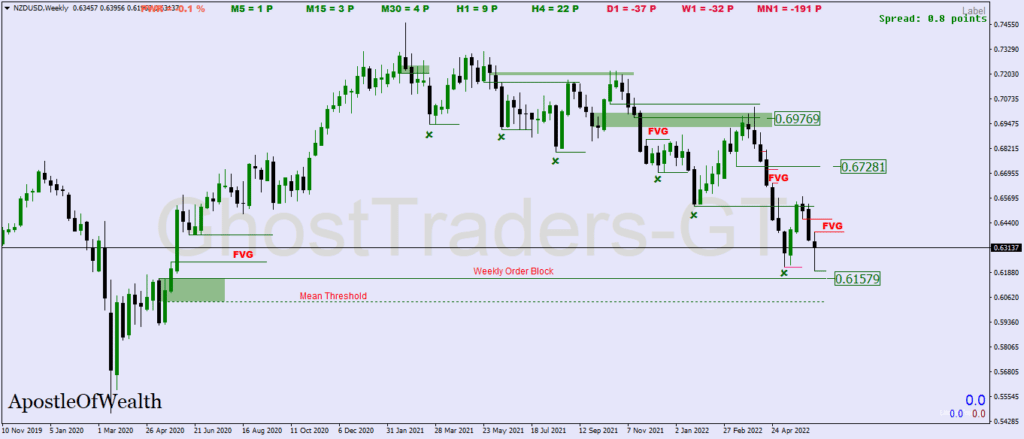
From The Chart Example, we can see how price declined significantly after closing our fair value gap. Based on the order flow being bearish, we can say this is a bearish fair value gap.
Price is most likely to reach out to areas where there are Fvg and Liquidity voids. The understanding of order flow trading should be coupled with fvg and liquidity void to select the best fair value gaps and liquidity voids.
Why FVGs Form
Fair Value Gaps are not random. They are the direct result of institutional order flow and algorithmic market behavior:
Imbalance in Order Flow: When the market moves too quickly in one direction, certain price levels do not get traded as much. This creates an imbalance between buyers and sellers at those specific levels.
Liquidity Hunt: Institutions deliberately create imbalances to trap retail traders and collect liquidity before making their actual move. FVGs are often byproducts of these liquidity sweeps.
Algorithmic Efficiency: The market operates on algorithms designed to seek and fill inefficiencies. Once an FVG is created, the algorithm flags it as an area requiring rebalancing.
Urgency in Execution: Large institutional orders are executed with urgency to avoid slippage and front-running. This urgency creates gaps as price leaps from one level to another without proper fill.
Types of Fair Value Gaps
Not all Fair Value Gaps are created equal. Context, location, and market structure determine the quality and reliability of each FVG.
Bullish Fair Value Gap
A Bullish FVG forms during an aggressive upward move. The gap appears between the high of the first candle and the low of the third candle. This type of gap suggests that buyers overwhelmed sellers, creating an imbalance to the upside. When price retraces into this gap, it often finds support and bounces higher, continuing the uptrend.
Bearish Fair Value Gap
A Bearish FVG forms during an aggressive downward move. The gap appears between the low of the first candle and the high of the third candle. This type of gap indicates that sellers dominated buyers, creating an imbalance to the downside. When price retraces into this gap, it often finds resistance and drops lower, continuing the downtrend.
To identify the ideal bearish fair value gap, check for the FVG at the premium level or above the discount of the defined range using Fibonacci Levels. Similarly, to identify a bullish fair value gap, look for the FVG below the discount level of your defined range using Fibonacci Levels.
Displacement FVGs
Displacement FVGs occur during extremely volatile moves where price makes a sudden, violent shift in direction. These gaps are often larger and more pronounced than standard FVGs and carry higher significance because they represent a decisive shift in market sentiment and order flow. They are typically found at the beginning of major trends or following significant news events. They signal that smart money has entered aggressively and that the market structure has fundamentally changed.
Breakaway Fair Value Gap
A Breakaway Fair Value Gap is a significant price gap that occurs when price breaks out of a consolidation phase or trading range. This is a crucial concept used by experienced traders to gauge the strength of a trend and identify potential trading opportunities. These gaps can manifest in both bullish and bearish markets and are characterized by a sudden surge in trading volume. In a bullish breakaway gap, price breaks above a resistance level, signaling that buyers have gained control of the market.
In essence, breakaway gaps are a powerful signal of changing market dynamics, and their persistence reflects the uncertainty and caution among traders during these pivotal moments in the market.
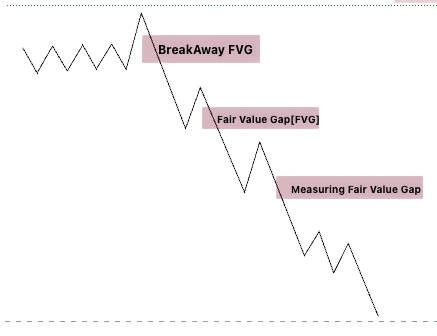
Measuring Fair Value Gap
In addition to Breakaway Gaps, there is another crucial concept known as the Measuring Fair Value Gap. It forms following a Fair Value Gap and plays a unique role in analyzing market dynamics. The Measuring Fair Value Gap is characterized by its tendency to remain open. This persistence occurs because heavy institutional order flow often surrounds it, pushing prices consistently in one direction. As a result, the Measuring Gap is less likely to be closed. Its primary purpose is to act as an indicator of institutional order flow in a specific direction. When a bearish Measuring Fair Value Gap appears, it signals a dominant bearish order flow in the market.
In summary, the Measuring Fair Value Gap serves as a valuable tool for traders to identify and interpret institutional order flow. Its persistence and direction provide valuable insights into the prevailing market sentiment, helping traders make more informed decisions.
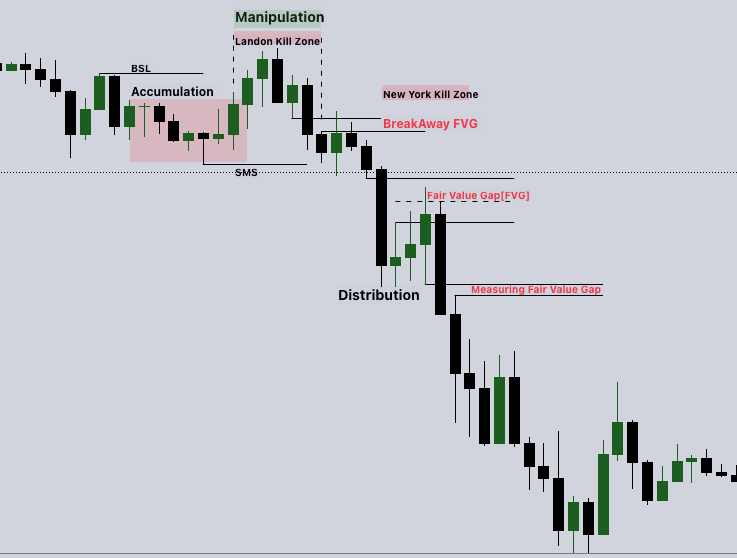
How to Identify Fair Value Gaps on Your Chart
Step 1: Look for Aggressive Three-Candle Moves
Scan your chart for areas where three consecutive candles form with a sharp, impulsive move in the middle candle. The first and third candles should not overlap in their wicks or bodies, creating a visible gap on the chart.
Step 2: Measure the Gap
The gap is the space between the high of the first candle and the low of the third candle (for bullish FVGs), or between the low of the first candle and the high of the third candle (for bearish FVGs). This space represents the imbalance that will later act as a magnet for price.
Step 3: Confirm the Timeframe
FVGs appear on all timeframes, but not all are equally significant. Higher timeframe FVGs (4-hour, daily, weekly) carry more weight and are more reliable than lower timeframe gaps. Focus your attention on gaps formed on higher timeframes for the best probability setups.
Step 4: Check Market Structure
An FVG in isolation is not enough. You must evaluate the broader market structure. Is the gap aligned with the prevailing trend? Does it sit at a key structural level? The most reliable FVGs are those that align with the dominant order flow and occur at significant support or resistance zones.
How to Trade the Fair Value Gap Strategy
Order Flow Bias First
Before entering any FVG trade, establish your directional bias through order flow. The understanding of order flow trading should be coupled with FVGs and liquidity voids to select the best setups. Look at daily order flow first; if it is not clear, switch to the H4 and H1 timeframes. Your directional bias must align with the type of FVG you are trading. Trading a bullish FVG in a bearish market is low probability.
Wait for Price to Return to the Gap
Once you have identified a valid FVG, mark the gap on your chart and wait. Price will eventually return to fill the imbalance. Do not chase price into the gap. Let it come to you. Patience here is mandatory, not optional.
Look for Confirmation
When price reenters the FVG zone, drop to a lower timeframe and look for confirmation signals. These can include rejection candles, market structure shifts on lower timeframes, volume spikes indicating institutional interest, or confluence with other support or resistance levels.
Entry, Stop Loss, and Take Profit
Enter your position within the FVG zone. For stop loss placement, put it just beyond the fair value gap: below the low of the FVG for bullish setups, and above the high of the FVG for bearish setups. For take-profit levels, target nearby liquidity pools or the next significant area of interest such as previous highs or lows. If the move is strong and aligned with a larger trend, consider using a trailing stop to maximize profits.
Reversal Trading with Fair Value Gaps
One of the most common strategies involving FVGs is reversal trading. When price collects sell-side or buy-side liquidity, traders anticipate either a reversal, retracement, or continuation. In reversal trading, the focus is on using a fair value gap as the entry point.
Sell Setup: When price collects buy-side liquidity (BSL), anticipate a reversal. Wait for a shift in market structure to confirm the anticipated reversal, then look for a fair value gap and use it as an entry point to sell short.
Buy Setup: When price collects sell-side liquidity (SSL), anticipate a reversal. Wait for a shift in market structure to confirm, then look for a fair value gap and use it as an entry point to buy or enter long.
Consequent Encroachment (CE) and IOFED
Consequent Encroachment
Consequent Encroachment (CE) is when a fair value gap is filled by 50%. This is referred to as the mean threshold of the FVG. Traders should keep in mind that price might not fill the entire FVG, so targeting the mean threshold is the ideal approach to avoid missing trades.
Institutional Order Flow Entry Drill (IOFED)
IOFED stands for Institutional Order Flow Entry Drill. It refers to situations where price retraces into a Fair Value Gap but reverses before reaching the 50% midpoint. In other words, institutional order flow is so dominant in one direction that the market does not even need to fill half the gap before continuing the original move.
This matters because it creates an earlier and often cleaner entry opportunity than waiting for a full gap fill or even a fill to the 50% level. For traders, IOFED presents opportunities to enter trades earlier, reducing the likelihood of missing out on moves due to incomplete gap fills.
If price shows rejection before the midpoint, you have an IOFED setup. If it fills toward the middle zone and holds, you have a Consequent Encroachment entry.
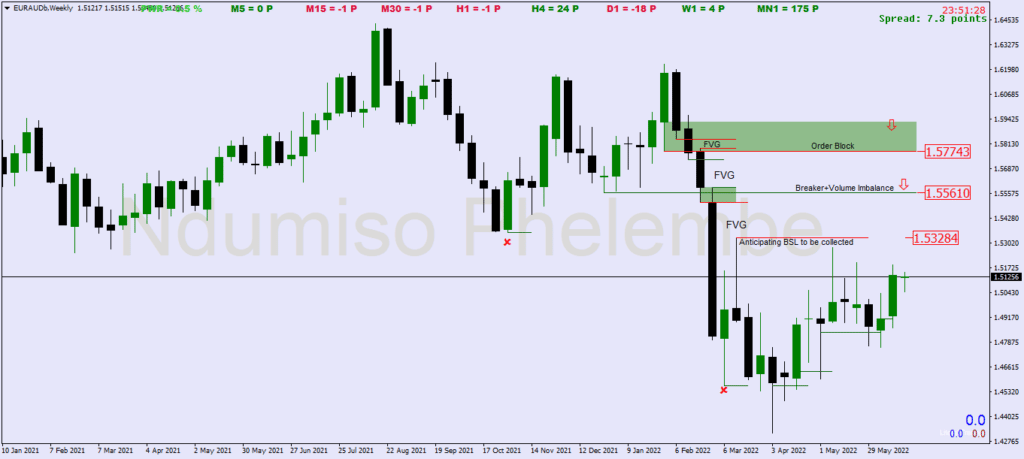
FVG Mitigation vs. Invalidation
Understanding the difference between mitigation and invalidation is critical for managing FVG trades effectively.
Mitigation: An FVG is mitigated when price enters the gap and institutions or traders, execute their pending orders in that zone. Price usually shows a reaction at this point, either reversing or continuing based on the new balance of buy and sell orders.
Invalidation: An FVG is invalidated when price fills the gap completely and continues moving strongly against your directional bias. Once the gap no longer offers the liquidity imbalance it once did, it loses its predictive power. If the gap contradicts your overall market view, it should be disregarded.
How Long Are Fair Value Gaps Valid?
There is no expiration date on Fair Value Gaps. They remain valid indefinitely until price reenters and fills the gap. The market does not care about time in these cases; liquidity is what drives the move. That said, fresher FVGs carry more weight than older, unfilled gaps. Relevance may diminish if the gap becomes outdated compared to more current market structures.
Liquidity Voids and How They Differ from FVGs
Liquidity voids occur when price moves rapidly in one direction, forming large candlesticks with minimal trading activity. These voids represent a price imbalance that, over time, the market tends to revisit and fill. Liquidity voids are essential indicators of inefficiencies in price movement and can be used alongside fair value gaps and order blocks for stronger trading confluence.
While both Fair Value Gaps and Liquidity Voids represent gaps in price action, they differ in cause and significance. All FVGs are liquidity voids, but not all liquidity voids qualify as FVGs. The distinction matters when marking zones on your chart. FVGs provide more precise entry levels defined by the three-candle pattern, while liquidity voids are larger, less defined areas. Traders typically engage with liquidity voids, fair value gaps, and order blocks together after observing a shift in market structure, which enhances the accuracy of their trade setups.

The Best Fair Value Gap to Trade
To identify the ideal bearish fair value gap, check for the fvg at the premium level or above the discount of the defined range using Fibonacci Levels. Similarly, to identify a bullish fair value gap, look for fvg below the discount level of your defined range using Fibonacci Levels.
How to trade order blocks with fair value gaps
As defined before in this article, what are Order Blocks? An Order Block (OB) in forex is a change in the state of price delivery indicated by the last up or last down close candle, with a fair value gap as an order block validator. Whilst a fair value gap is a price gap that indicates buy-side inefficiency (sell-side imbalance) or sell-side inefficiency (buy-side imbalance) in the market.
When trading order blocks, fair value gaps are used to determine whether an order block is likely to hold or fail. An order block without a fair value gap is more likely to fail and should be avoided, as the presence of a fair value gap is what confirms the strength and completeness of an order block.
Liquidity Voids and How They Differ from FVGs
Fair value gaps and liquidity voids are both indicators of sell-side imbalance and buy-side imbalance in trading. The only difference is how they are represented on the chart. Liquidity voids occur when price moves sharply in one direction, forming long-range candles, whilst a fair value gap is a price gap. Liquidity voids are essential indicators of inefficiencies in price movement and can be used alongside fair value gaps and order blocks for stronger trading confluence.
While both represent gaps in price action, they differ in cause and significance. All FVGs are liquidity voids, but not all liquidity voids qualify as FVGs. The distinction matters when marking zones on your chart. FVGs provide more precise entry levels defined by the three-candle pattern, while liquidity voids are larger, less defined areas. Traders typically engage with liquidity voids, fair value gaps, and order blocks together after observing a shift in market structure, which enhances the accuracy of their trade setups.
How To Trade Fair Value Gaps
When price collects sell-side or buy-side liquidity, we anticipate either a reversal, retracement, or continuation. In this case of fair value gap trading, our main focus is trading reversal using a fair value gap as our entry point.


Common Mistakes When Trading FVGs
Trading Against the Trend: One of the most costly mistakes is trading FVGs that oppose the prevailing market structure. Always align your FVG trades with the dominant trend and order flow direction.
Entering Without Confirmation: Jumping into an FVG zone without waiting for lower-timeframe confirmation leads to premature entries and stopped-out trades. Always wait for rejection patterns or structure shifts.
Ignoring Higher Timeframes: Lower timeframe FVGs generate more noise and false signals. Focus on 4-hour, daily, and weekly FVGs for the most reliable setups.
Overtrading Every Gap: Not every FVG deserves a trade. Be selective. Only trade gaps that align with multiple confluences including trend, structure, and liquidity context.
Poor Risk Management: Failing to set proper stop losses or taking profits too early destroys the edge that FVGs provide. Stick to your plan and let winners run.
Frequently Asked Questions
Does the Fair Value Gap work? Yes, Fair Value Gaps can be extremely effective, but their success largely depends on the trader’s ability to interpret market structure and identify the right conditions. FVGs do not operate in isolation. They require a deep understanding of institutional order flow, liquidity, and context within the overall trend.
Are Fair Value Gaps always filled? Fair value gaps are usually filled, but the timing can be uncertain. While price eventually seeks to balance inefficiencies, the market may take longer than expected to revisit these areas. Patience is key. Unfilled orders do not expire; they remain valid until the market finds the liquidity needed to rebalance those areas.
Is the Fair Value Gap the same as an imbalance? Theoretically, both represent inefficiencies in price, but they are different concepts in practice. FVG is a specific form of imbalance identified within a three-candle pattern, while an imbalance can refer to any price area where trade flow is unbalanced. In most trading contexts, the terms are used interchangeably, but FVG is the more precise technical term.
What is the difference between FVG and Liquidity Void? A Liquidity Void describes any area on the chart where minimal trading occurred due to rapid price movement. An FVG is a specific type of liquidity void defined by the three-candle pattern. The FVG provides more precise entry levels, while liquidity voids are larger, less defined areas.
Conclusion
Fair Value Gaps are one of the most powerful tools available to price action traders. They reveal the footprints of institutional activity and provide precise zones where the market is likely to react. By understanding how FVGs form, why price returns to them, and how to trade them with proper confirmation, you gain a significant edge over traders who rely solely on lagging indicators.
The complete formula for FVG trading success is threefold. First, identification: find valid gaps formed by three-candle patterns with clear imbalances. Second, context: trade only the FVGs that align with the prevailing trend and market structure. Third, execution: enter on lower-timeframe confirmation, set precise stops, and manage risk aggressively.
Master these principles, backtest extensively, and you will develop an intuitive sense for which FVGs offer the highest probability setups. The market leaves clues everywhere. Fair Value Gaps are among the clearest.
Hey, Check Our Instagram account and stay updated.