
Last updated on April 1st, 2026 at 07:10 am
Understanding the Power of 3 (PO3) is crucial for successful intraday trading. Power of 3 (PO3) consists of three key elements: accumulation, manipulation, and distribution. During accumulation, price collects orders on both sides of the market. Manipulation is when price deliberately moves in a false direction to trick traders into taking the wrong position or getting knocked out of their positions.
Finally, distribution occurs when accumulated positions are released after manipulation, usually near the high or low of the day, depending on the market’s direction. By comprehending these three elements, traders can make more informed decisions and better navigate market dynamics.
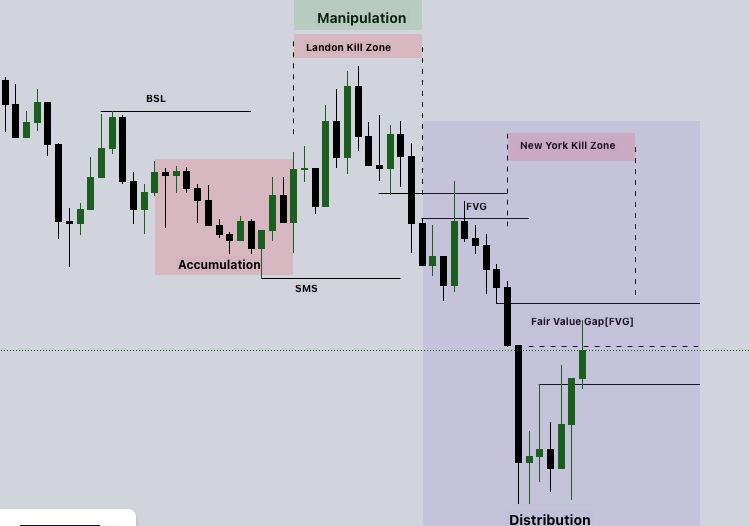
Power of Three Trading with Forex Trading Sessions
The PO3 cycle maps directly to how the three main forex sessions behave throughout the trading day.
- The Asian session runs from Midnight to 4:00 AM NYT UTC-5. This is typically where accumulation happens. Price ranges quietly as institutions build their positions.
- London Session is open from 2:00 AM to 11:00 AM NYT UTC-5. The manipulation phase often fires here. False breakouts, stop hunts, and liquidity grabs into the Asian range highs and lows are common at the London open.
- New York Session is open from 7:00 AM to 4:00 PM NYT UTC-5. Distribution plays out here. The true trend commits, and the market moves in the direction institutions intended all along.

PO3 Phases
1. Accumulation
This phase represents the initial stage where smart money, typically institutional traders or market makers, starts accumulating positions in a particular asset. During this phase prices are often stable or in a consolidation pattern.
How to identify accumulation: look for price consolidating or ranging during low volatility periods such as the Asian session or pre-market hours. Price oscillates between support and resistance without breaking out, which signals that institutions are quietly building positions.
Be patient during accumulation. Avoid entering trades prematurely. Focus on identifying the boundaries of the range because the breakout from this phase signals the start of manipulation.
2. Manipulation
The manipulation phase follows accumulation. It involves smart money manipulating price to create a specific market sentiment. This includes fakeouts and stop-hunting to lure retail traders into the market before the real move begins.
How to identify manipulation: look for a false breakout above or below the accumulation range where price briefly breaks a key level and quickly reverses. Watch for price spikes into liquidity zones such as above recent swing highs or below recent swing lows. The manipulation phase is often marked by a rapid price move that seems to trap traders in the wrong direction.
Stay cautious and avoid chasing price during manipulation. This phase exists to trick retail traders. Wait for it to complete before considering an entry.
3. Distribution
After manipulating price, smart money enters the distribution phase. In this stage they start releasing accumulated positions, driving the market in the intended direction. This creates the true trend for the session.
How to identify distribution: after the manipulation phase false breakout, price reverses and breaks out in the opposite direction. Distribution is often accompanied by strong momentum and directional candles, confirming that institutional traders are in control. This phase typically lasts until a key level of support or resistance is reached.
Once distribution begins, enter trades in the direction of the new trend. Place your stop loss just beyond the manipulation zone to protect against any further false moves.

The Power of 3 trading strategy aims to identify and capitalise on these phases to make profitable trades. Traders using this strategy look for specific price patterns and institutional reference points that signal the transition between these phases.
Practical Application of the PO3 Trading Strategy:
- Identify a period of consolidation or ranging market. This is a sign that market makers are accumulating assets.
- Look for a key price level such as Fair Value Gaps (FVG) or Order Blocks for entries. These are levels where market makers are likely to place their orders.
- Wait for a false breakout or stop-loss hunt to occur /Buy side or sell side liquidity to be collected. This is a sign that market makers are manipulating the market.
- Enter a trade in the direction of the main trend.
- Place your stop loss below the key price level.
- Take profit at your next target level.
Trade Example Using PO3
Here is how PO3 plays out on a 15-minute EUR/USD chart during the London session.
Accumulation: During the early hours of the London session EUR/USD consolidates in a tight range between 1.1000 and 1.1020. This is the accumulation phase where institutional traders are building their positions.
Manipulation: Shortly after the London open, price spikes above the range to 1.1030, triggering stop losses above the accumulation zone. Price quickly reverses, confirming this was a false breakout designed to create liquidity.
Distribution: After the manipulation, price breaks below the accumulation zone at 1.1000 and begins trending downward. Smart money is distributing and driving price lower. A short entry at 1.1000 with a stop loss above the manipulation high at 1.1030 captures the move.
Trade outcome: Price continues dropping to key support at 1.0950, which was the original liquidity target. Profits taken there or with a trailing stop for further downside.
This is the PO3 cycle in action. Accumulation sets the range, manipulation grabs liquidity above it, distribution delivers the real move below it.
New York PM Session and PO3
The New York PM session runs from 12:00 PM to 4:00 PM NYT UTC-5. This is a window that many traders overlook but it is one of the most reliable periods for PO3 setups to complete or confirm.
During the PM session, institutions reposition and adjust orders before the day closes. The session either extends trends started during London or reverses false moves that happened earlier in the day. Three things make this session worth watching.
Order flow continuation: institutions often use the PM session to extend trends initiated during the London session. If distribution started during the New York morning kill zone, the PM session frequently provides the continuation to the target.
Liquidity injections: US economic data releases or late-day market adjustments can generate sharp moves during this window that align with the daily PO3 structure.
Trend reversals: if the London session produced a false move, the PM session is where the structure shift happens, and the true direction is confirmed. This is one of the most reliable reversal windows in the model.
H3: Three PM Session Setups to Watch
Retracement into a New York Order Block
Order blocks that formed during the London session act as magnets during the PM session. When price retraces into a London order block in the afternoon, that retracement is often the distribution continuation entry.
Identify a bullish or bearish order block on the 15-minute or 1-hour chart formed earlier in the day. Let price retrace into it during the PM session. Wait for a confirming candle showing rejection from the block. Set your stop beyond the order block and target the next liquidity pool or session high or low.
Market Structure Shift in the PM Session
If London produced a liquidity grab without a clean distribution, the PM session often delivers the market structure shift (MSS) that confirms the true direction.
Wait for price to break above or below the most recent swing high or swing low, signalling a shift in structure. Enter on the retest of the broken structure or a newly formed order block. Target a significant liquidity zone or fair value gap further along in the trend direction.
Liquidity Hunt and Reversal
Institutions sometimes run a liquidity hunt during the PM session, targeting retail stop losses placed at London session highs and lows before reversing.
Mark the London session highs and lows before the PM session opens. During the PM hours, watch for price to spike above or below these levels and trigger stops. Once the liquidity grab is confirmed with a reversal candle, enter in the opposite direction. Stop goes just beyond the liquidity grab with target at the next swing high or low.
Common Mistakes to Avoid
Chasing the first move: do not enter based on the initial breakout during manipulation. That move exists to trap you. Wait for the liquidity grab to complete and the structure shift to confirm.
Ignoring session timing: the PO3 cycle follows session time windows. Trading the manipulation as if it is distribution, or entering during accumulation, puts you on the wrong side of the model every time.
Skipping the PM session: many traders close up after the New York morning kill zone and miss the PM session setups entirely. Some of the cleanest distribution and reversal moves of the day happen between 12:00 PM and 4:00 PM NYT UTC-5.
Overlapping market structure shifts: always monitor for structural breaks. They signal that a phase transition has occurred. Trading without confirming the MSS means you are guessing which phase the market is in.
Tips for Using the Power of 3 Trading Strategy
- Use the 4-hour or daily chart to determine the larger trend before looking for PO3 setups on lower timeframes.
- Mark session highs and lows before each kill zone. These are your liquidity targets.
- Use multiple timeframes to confirm your trade setups.
- Be patient and wait for the right trade setup. The manipulation phase exists to rush you in. Do not let it.
- Always wait for price action confirmation, such as a market structure break or strong momentum candles, before entering.
- Use proper risk management and position sizing on every trade.
- Backtest the PO3 model on historical data before using it in live trading.
It is important to note that the Power of 3 strategy, like any trading strategy, requires careful analysis and risk management. There will be times when market makers do not follow the typical three-phase pattern. However, by understanding PO3 concepts, traders can improve their chances of success. Successful implementation involves a deep understanding of market dynamics and the ability to recognise the signs of accumulation, manipulation, and distribution in real time.
